The Suitcase Generation: Finding Uganda's Gujaratis on Belgrave Road
Walk the Golden Mile on a Tuesday morning and you will see a street that looks like it has always been here. Sweet counters stacked with barfi, a queue for chai, a shopkeeper shouting a price across the pavement, a temple doorway with shoes piled outside. None of it is older than living memory. The Belgrave Road that visitors come for was largely made in the space of about fifteen years — and a great deal of it was made by people who arrived with one suitcase and no intention of going back.
A Victorian street that got a second life
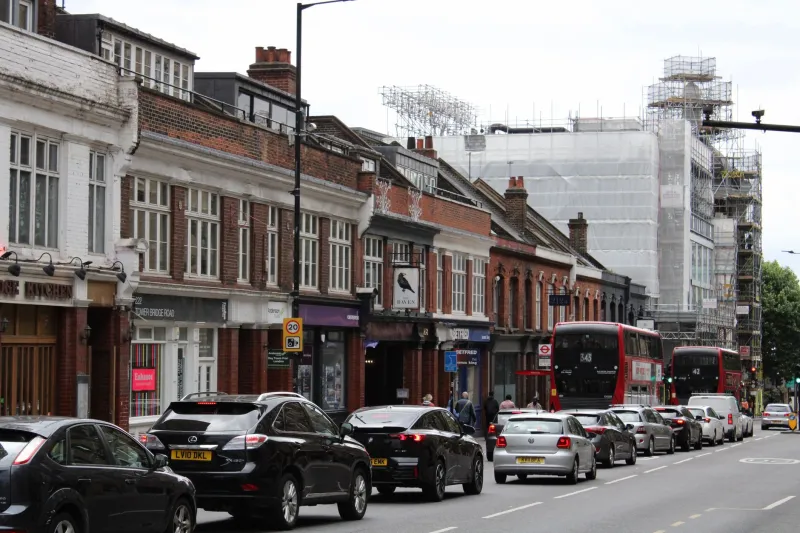
Start with what was already there. Belgrave Road is a Victorian shopping street, laid out to serve the terraces that grew up around the shoe and hosiery trade. Brick, bay windows, corner shops with glazed tiles. By the 1960s it was a perfectly ordinary Leicester high street, and it was starting to look tired.
Gujarati families had been arriving in Leicester since the late 1950s and early 1960s, many via East Africa — Kenya, Tanganyika, Zanzibar — holding British passports and looking for work. Most first settled around Highfields, close to the factories and the railway. The move north to Belgrave came later, and it came in a rush.
Ninety days, one suitcase
On 4 August 1972, Uganda's president Idi Amin gave the country's Asian population ninety days to leave. Around 50,000 people held British passports; roughly 27,000 came to the UK before the deadline in early November. Many were Gujarati families who had been in East Africa for two or three generations, running shops, pharmacies, garages and factories.
What they brought with them varied enormously — qualifications that Britain refused to recognise, savings frozen in Ugandan banks, and the habits of a trading family: keep the books tidy, know your customers, open early. What Leicester offered was housing that others no longer wanted and rents that a family could just about cover.
There is a detail in the archive that Leicester does not enjoy remembering. In 1972 the city council took out an advert in the Uganda Argus, warning families not to come because Leicester was already overcrowded. Thousands came anyway. Walk Belgrave Road today and you are walking through the answer to that advert.
The walk: six stops that hold the story
You can do this in ninety minutes, and it costs nothing but a cup of tea.
1. Belgrave Circle. Stand at the top of the road and look south. Until 2014 a concrete flyover dumped traffic onto this junction; its removal let the street breathe and let the shopfronts be seen again. The Circle is where the Golden Mile announces itself — the first sweet shop, the first gold jeweller, the first restaurant.
2. Rothley Street and the old library. The Victorian building around the corner was built as a public library, the kind of civic gesture the suburb was once proud of. Today it functions as a neighbourhood centre, and it is the sort of place where the same families have been booking halls for weddings for three generations. Look at the stone lettering before you go in.
3. Weymouth Street. A short walk off the main road takes you to a mandir established in the early 1970s by families who had, in many cases, only just arrived. The story told by people who were there is always the same: a house, a room, a murti brought over in hand luggage, and a rota for cleaning. Grand buildings came later. Faith came first.
4. A sweet counter, any sweet counter. The mithai shops are the closest thing the Mile has to a public record office. Recipes are regional and family-specific: Gujarati farsan here, Punjabi sweets there, a counter that has sold the same jalebi since the seventies. Ask what is fresh. It is the fastest conversation you will have all day.
5. A restaurant that has outlasted its founders. Several of the Mile's best-known kitchens opened in the 1970s and 1980s and are now run by the second or third generation. The menu has changed less than the customers think — the thali is still the honest measure of a Gujarati kitchen, and it is still cheap.
6. The last stretch towards the city. Heading south, the shops get smaller and the wholesale trade takes over. This end is where families who started with a market stall graduated to a unit, then to a unit with a car park. It is the least photogenic part of the Mile and the most revealing.
What you hear when people talk about it
The recollections are remarkably consistent, and they are not sentimental. A woman who arrived as a child in 1972 remembers her father refusing to sell the family's gold and instead borrowing to lease a shop. A shopkeeper in his seventies describes the first winter as the shock — the cold, the damp terraces, the rationing of ambition. A younger man, born in Leicester, says his grandfather never once described Uganda as home, and never once described Leicester as anything else either.
That is the tone you get on the Mile: practical, unsentimental, faintly amused by the way other people talk about it. The businesses were not built as heritage. The heritage is a side effect of the businesses surviving.
Reading the street without treating it as a museum
A few things worth knowing before you go. Belgrave Road is a working high street, not a visitor attraction, and the busiest trading hours are not the best time to stand in a doorway taking photographs. Ask before you photograph people or shop interiors. Many shops close for an hour or two in the afternoon; Friday lunchtime is frantic and Sunday morning is quiet. The Diwali lights along the road, switched on each autumn, are the one moment of the year when the street openly invites a crowd. The rest of the year it asks you to behave like a customer.
That is the right way to see the Ugandan Gujarati story, in any case. Buy something. Sit down. Eat. The history is legible in the ledger books, in the names above the doors, in the way a family that lost everything in 1972 now owns three units and a car park. It is not in a display case, and it does not want to be.
Practical notes
Belgrave Road runs north-east out of Leicester city centre; buses along Belgrave Gate and Melton Road stop close to the top of the Mile, and there is pay-and-display parking off the side streets, though it fills quickly at weekends. Allow two hours if you want the walk plus a proper sit-down thali. Go on a weekday morning if you want the shopkeepers to have time to talk, and go in the evening if you want the street at its loudest and best.