Eight Mithai Counters on Belgrave Road Worth Building a Box Around
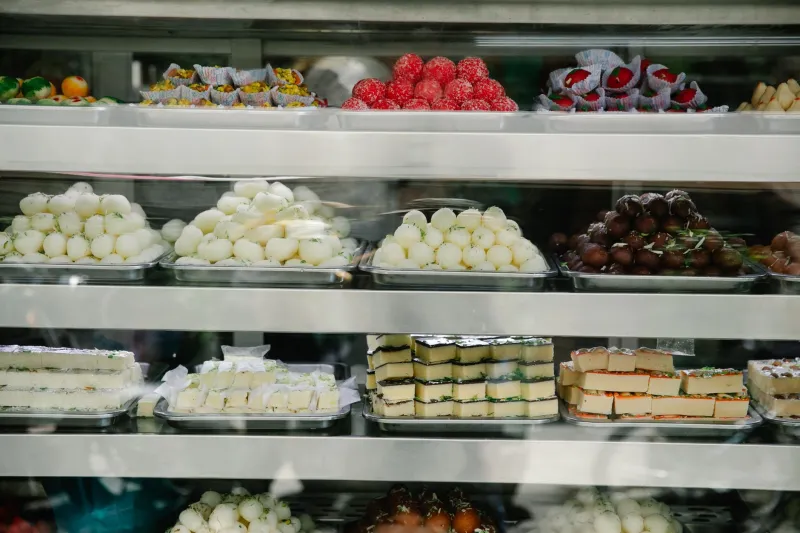
There is a particular smell that hits you somewhere between Belgrave Circle and the railway bridge: warm ghee, green cardamom, and sugar syrup hitting a hot pan. That is the Golden Mile doing what it has done for decades — feeding people, and feeding them properly.
Buying mithai on Belgrave Road is not a quick errand. It is a conversation, a sample or two, and usually a friendly disagreement about who does the best kaju katli. What follows is a practical trail through eight counters, with notes on what to order and how to put together a box that will not embarrass you at a family gathering.
First, how the counters work
Almost everything is sold by weight. Expect roughly £9 to £16 per kilo depending on how much ghee, nuts and pistachio are involved — kaju katli and anything pistachio-heavy sits at the top of that range, while plain besan ladoo and syrup sweets sit lower. Most shops will let you point at trays and build a half-kilo or a kilo. Say straight away whether the box is for a gift, because the good places will pack it in a proper presentation box with a lid rather than a flimsy bag.
Milk-based sweets (barfi, peda, kalakand, gulab jamun) are best eaten within three to five days and should be kept cool. Nut-based sweets keep longer. Jalebi keeps about twenty minutes, which is the point.
Stop 1: Bobby's — the benchmark
Start here because everyone else will be measured against it. The kaju katli is the standard order: thin, pale, almost translucent at the edge, with the silver leaf left on. Buy 250g, eat one in the shop, and you will understand why the queues form around Diwali. Their namkeen counter is also worth a look if you want something salty to balance the sugar.
Stop 2: Ambica Sweet Mart — old-school barfi
A more traditional counter, the sort of place where the trays are replenished from the back and the staff will tell you honestly which batch is freshest. Order the plain milk barfi and the chocolate barfi, and ask for a piece of the coconut to try. This is where you learn that barfi is not one thing but a whole family of things.
Stop 3: Mithaas — the easy introduction
Bright, tidy and well labelled, which makes it a good first stop if you are new to mithai and do not want to guess. Gift boxes are a strong point here, and the chaat counter means you can turn a sweet run into lunch. Good for office boxes and for anyone who needs a nut-free or clearly marked option.
Stop 4: The hot jalebi stop
You will smell it before you see it — batter spiralling into hot oil, then straight into syrup. Buy a small paper bag, stand on the pavement, and eat them while they are still warm and crisp at the edge. Do not put jalebi in a mixed box; it goes soft and sad within the hour. This is a now food, not a later food.
Stop 5: Sona Sweet Mart — milk sweets and peda
Where to go for peda, kalakand and the dense, milky sweets that Gujarati and Punjabi households both argue over. Ask which is made that morning. A good peda should still be slightly warm in the middle if you are lucky.
Stop 6: Rajwadi Sweet Mart — sweetness plus farsan
The smart move here is to buy both. A box of sweets with no savoury balance is a box that gets abandoned by 4pm. Add chevdo, sev and a bag of mixture, and your spread suddenly looks like someone thought about it.
Stop 7: Shreeji Sweet Mart — ladoo territory
Motichoor ladoo, besan ladoo, and the slightly coarser boondi versions. Ladoo are the workhorses of any celebration: sturdy, forgiving, easy to stack and impossible to ruin in a car. Buy these for the box and keep the delicate stuff for the plate.
Stop 8: Pooja Sweet Centre — the small-counter finish
Finish somewhere modest, where the trays are shallower and the range changes with the season. Soan papdi, seasonal specials and small batches are the appeal. Ask what has been made most recently and take a chance on it.
Shop names and counters on Belgrave Road do shift, so check opening hours before making a special trip, especially on Mondays.
How to build a mixed box that works
The rule of thumb used by most families here is roughly three nut-based sweets, three milk-based sweets, two syrup-based sweets and one bright, colourful thing for the look of it. For a box feeding eight to ten people, aim for about 1kg to 1.25kg and expect to spend £15 to £20.
A reliable combination: kaju katli, plain barfi, peda, motichoor ladoo, gulab jamun, chocolate barfi, soan papdi and a pistachio roll. Keep the wet sweets (jamun, rasmalai) in a separate tub because they will leak into everything else.
Diwali 2026 and the festival rush
With Diwali falling on 8 November this year, the Golden Mile is already in full swing, and the last few days before the festival are the busiest of the whole calendar. Pre-order by phone or in person if you want a specific box, and collect early in the morning if you can. Shops that normally close late will be extending hours, and the queues are part of the experience rather than a reason to avoid it.
The same rhythm returns for Raksha Bandhan, Eid, Navratri and the wedding season, so the advice holds year-round: order ahead, go early, and never leave a box of milk sweets in a hot car.
Practical notes
Most shops take card now, but a bit of cash speeds things up. Parking around Belgrave Road is limited — the side streets off the main drag and the pay-and-display near Melton Road are the sensible options. Mornings between 10am and noon are calmest; late afternoon and any evening in the run-up to Diwali are not.