Look Up: The Case for Treating Belgrave Road's Shopfronts as Leicester's Real Heritage Attraction
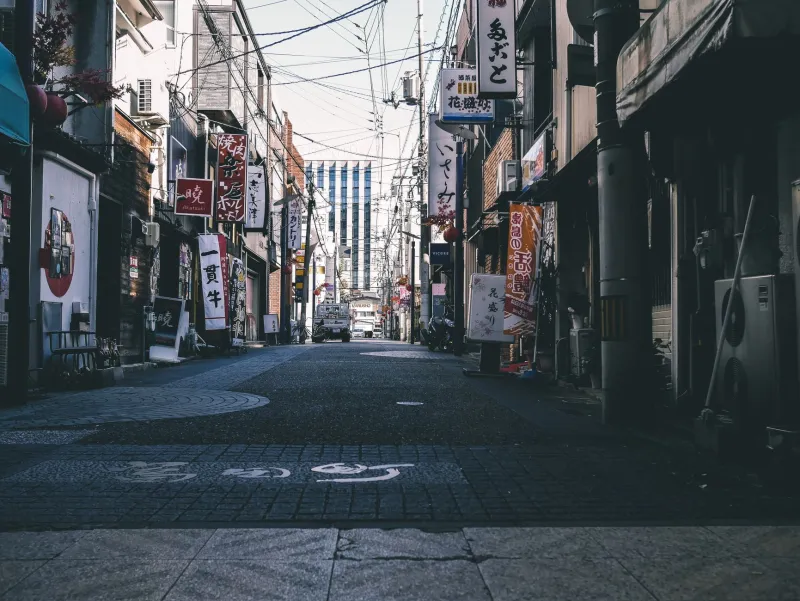
Leicester has no shortage of heritage. The Richard III story, the Guildhall, the Roman remains under the old town — all properly labelled, properly lit, properly explained. And yet the most revealing historical document in the city might be a faded awning above a saree shop on Belgrave Road, put up in 1987 and never quite replaced.
The case for looking up
Walk the Golden Mile with your eyes at pavement level and you will see what every high street looks like: bins, bollards, buses. Walk it with your eyes on the first floor and everything changes. Here is an old Victorian terrace shopfront with a Gujarati nameboard bolted across it. There is a former Co-op or cinema or bank, its stone lintel still visible above a modern aluminium frame. Around the corner, a temple entrance has been carved into what was once a warehouse.
That layering is the story. Migration in Britain is usually told as a national narrative — arrival, work, community, change — and it always sounds abstract. On Belgrave Road it is physical. You can trace it in brick, glass and paint, in about a mile and a half of walking.
Four things to look for
The signs themselves. Hand-painted lettering, transliterated names, phone numbers with the old Leicester dialling code. Some are works of art. A few are the last surviving examples of a signwriter's trade that has essentially gone.
The thresholds. Temples, shops and community buildings all deal with the same problem: how do you turn a Victorian commercial building into somewhere people take their shoes off? Ramps, porches, tiled steps and shoe racks are all evidence of adaptation.
The upper floors. Shopkeepers rarely alter above their own ceiling. Chimneys, sash windows and decorative brickwork from the 1890s sit directly above 2020s LED signage, and the contrast is the point.
The names. Family names on the frontage tell you who came, when, and often which part of Gujarat, Punjab or Kenya they arrived from. Some of those names have now been there longer than the shops that preceded them.
A 90-minute walk
Start at the Golden Mile gateway near Belgrave Circle, the arch that most people photograph and then walk straight past. Turn around and look back at it from twenty metres away: you get the whole street in one frame.
Head north-east along Belgrave Road. At the Sanatan Mandir, look at how the building meets the street — the entrance, the noticeboards, the way the pavement has become an informal gathering point.
Continue past the saree shops and jewellers. This stretch is where the shopfronts are most intact, so walk slowly and cross the road once to see the opposite terrace properly. Note the awnings: fabric, retractable, some patched, some new. Awnings are the most honest indicator of how long a business has actually been trading.
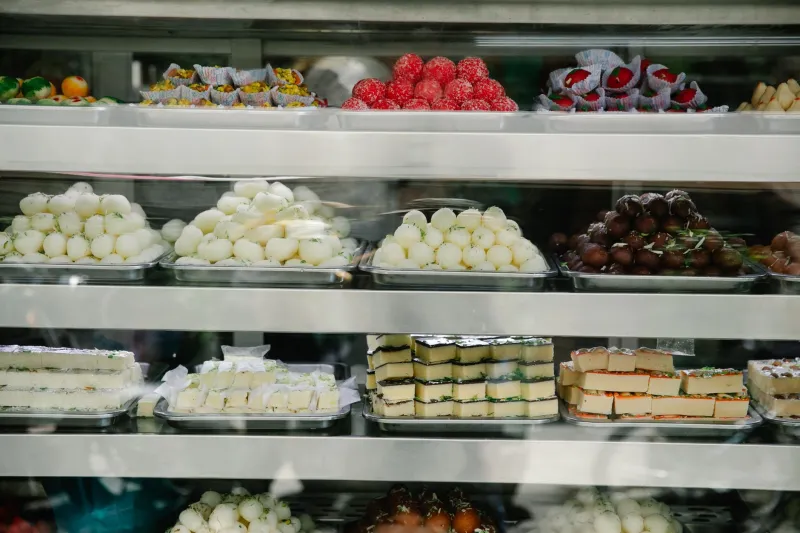
Pause at Bobby's, the sweet shop that has become a landmark in its own right, and consider how a retailer turns into a reference point. Ask anyone in Leicester where the Golden Mile is and they will describe it in relation to this stretch.
Carry on to the railway bridge, where the street narrows and the noise changes. Then loop back along the opposite side and finish with a detour to the Jain temple just off the main road — one of the clearest examples in the city of a religious building fitted into a residential and commercial terrace rather than standing apart from it.
What the shopkeepers say
Priti, who has worked the counter at a family saree shop for nineteen years, is clear about what has changed. The fabric trade has moved online, she says, and the shop is now as much a place for fittings, advice and weddings as it is for selling. The sign outside has not changed since her father-in-law's day, and she likes it that way.
Further along, Anil runs a hardware and household goods shop that has outlasted three neighbouring businesses. He points out that the street's real heritage is not the buildings but the habit of repair — the fact that you can still buy one hinge, one plug, one length of chain here rather than a multipack.
Yusuf, behind a counter selling incense and religious items, says the busiest days are still the festival days, just as they were when he started. The stock has diversified; the rhythm has not.
The changing face
Not everything should be preserved. Some shopfronts need new shutters, better lighting and a ramp that actually works. The temptation with heritage is to freeze a street, and freezing a working high street kills it. The argument here is not that Belgrave Road should be pickled, but that its ordinary commercial fabric deserves the same attention the city gives to a medieval wall.
A heritage strategy for this street would be cheap and effective: a photographic survey of every shopfront, a handful of small plaques explaining building dates, and planning guidance that stops the worst cladding. That is it. No visitor centre, no ticket desk.
Practical notes
The walk is flat, roughly 1.5 miles with the temple detour, and takes about 90 minutes at a browsing pace. Go on a weekday morning for the clearest views of the buildings; go on a Saturday if you want to see the street in full use. Dress respectfully if you plan to step inside any of the temples, and remember that most of this walk is on a busy road — cross at the marked points and keep your camera out of people's faces.